At first, many students used ChatGPT mostly out of curiosity.
Someone tested it for homework. Another tried summarizing notes. A few experimented with essay ideas late at night before deadlines.
Now things look very different.
AI tools quietly became part of daily academic life for millions of students worldwide.
That shift happened surprisingly fast.
Still, not every student uses ChatGPT effectively.
Some rely on it too heavily. Others barely scratch the surface of what it can actually help with.
The students getting the best results usually treat AI as a support tool rather than a replacement for learning itself.
Quick Overview:
- Students use ChatGPT for research, summaries, and productivity.
- AI works best when supporting learning instead of replacing it.
- Good prompts improve academic results significantly.
- Fact-checking still matters enormously.
- Simple AI workflows usually work better long term.
Why Students Started Using ChatGPT So Quickly
Modern academic workloads feel overwhelming for many students.
Assignments stack together. Research takes hours. Notes become messy. Deadlines overlap constantly.
ChatGPT entered that environment at exactly the right moment.
For many students, the biggest appeal was speed.
Instead of searching through multiple websites for basic explanations, students could ask direct questions and receive immediate responses.
That convenience changed study habits almost overnight.
Most students do not use AI because they dislike learning. They use it because academic pressure keeps increasing.
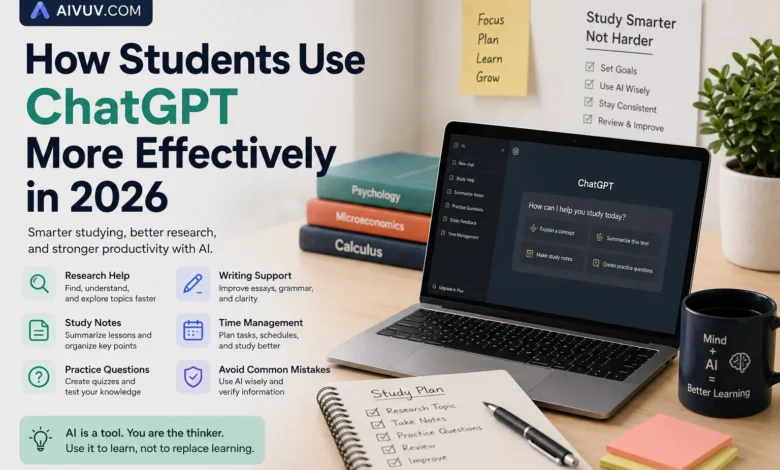
1. Research Support
Research remains one of the most common student use cases.
Many students use ChatGPT to:
- Understand unfamiliar topics
- Summarize concepts
- Generate research angles
- Brainstorm ideas
- Simplify difficult explanations
That does not mean AI replaces proper research entirely.
Students still need reliable sources, academic databases, and verified information.
Still, ChatGPT often reduces the time required to understand complex topics initially.
2. Study Notes and Summaries
This became extremely popular among students recently.
Long chapters, lecture notes, and study materials can feel overwhelming during busy semesters.
Many students now use AI tools to:
- Condense notes
- Create study outlines
- Simplify terminology
- Highlight key ideas
- Generate revision material
Funny enough, the best results usually happen when students review and edit summaries manually afterward.
Simply reading AI summaries passively is rarely enough for deep understanding.
3. Practice Questions and Self-Testing
One underrated use case involves practice exercises.
Students often ask ChatGPT to create:
- Quiz questions
- Flashcards
- Practice exams
- Scenario-based questions
- Short explanations
That approach works especially well for revision sessions before exams.
Interactive practice usually improves memory far more effectively than passive rereading.
4. Writing Assistance
Many students use ChatGPT during writing tasks now.
That includes:
- Essay brainstorming
- Outline generation
- Grammar improvement
- Sentence restructuring
- Clarity suggestions
Still, relying completely on AI-generated writing creates obvious problems eventually.
Teachers often recognize generic AI-heavy writing surprisingly quickly.
The strongest academic work still reflects personal understanding, structure, and original thinking.
Better Student Workflow:
- Research independently first.
- Use AI for clarification and organization.
- Review information manually.
- Edit outputs carefully.
- Add personal understanding and examples.
5. Time Management and Productivity
Students also use ChatGPT for organization surprisingly often.
Some common uses include:
- Study schedules
- Revision planning
- Task prioritization
- Productivity workflows
- Assignment breakdowns
That support becomes especially useful during exam periods when workloads increase heavily.
Why Fact-Checking Still Matters
This part remains extremely important.
ChatGPT still generates inaccurate information sometimes.
Students occasionally assume confident writing means reliable facts automatically.
That assumption creates academic problems quickly.
AI can:
- Invent references
- Oversimplify concepts
- Provide outdated information
- Misunderstand academic context
Checking sources remains essential, especially for serious assignments and research projects.
Common Mistakes Students Still Make
Even with better AI literacy today, students still repeat several common mistakes:
- Copying AI content directly
- Skipping source verification
- Using weak prompts
- Relying too heavily on summaries
- Expecting AI to replace studying completely
Usually, the strongest students use AI as a support layer rather than a shortcut around learning itself.
Why Simpler AI Workflows Often Work Better
Some students try building extremely complicated productivity systems immediately.
Multiple apps. Endless automation. Overloaded dashboards.
Funny enough, many experienced students eventually return to simpler systems instead.
Often, the most sustainable setup includes:
- One AI assistant
- One note-taking system
- One lightweight workflow
- Consistent study habits
Simple systems create less friction long term.
Useful Resources
Final Thoughts
Students use ChatGPT more effectively in 2026 when they combine AI support with genuine learning habits.
The tool works best for:
- Organization
- Clarification
- Summarization
- Brainstorming
- Productivity support
Not for replacing understanding completely.
Funny enough, the students benefiting most from AI usually remain deeply involved in the learning process itself.
They ask better questions. Verify information carefully. Edit outputs manually. Build stronger workflows gradually.
That balance matters far more than simply generating faster answers.
Frequently Asked Questions
How do students use ChatGPT for studying?
Students commonly use ChatGPT for summaries, explanations, brainstorming, note organization, and practice questions.
Can ChatGPT replace studying completely?
No. AI can support learning, but deep understanding and independent thinking still matter enormously.
Is ChatGPT useful for research?
Yes, especially for topic exploration and summaries, but students should still verify information using reliable sources.
What mistakes do students make with AI tools?
Common mistakes include copying content directly, skipping fact-checking, and relying too heavily on summaries.
What is the best way students should use AI?
The strongest approach combines AI support with active learning, manual review, and critical thinking.