Artificial intelligence feels almost impossible to ignore now.
Every week, new tools appear promising faster workflows, smarter automation, better creativity, and easier productivity.
Some claims sound impressive.
Others sound unrealistic almost immediately.
That confusion creates a strange situation for beginners.
Many people either expect AI to solve everything or assume the technology is mostly hype.
Reality sits somewhere between those extremes.
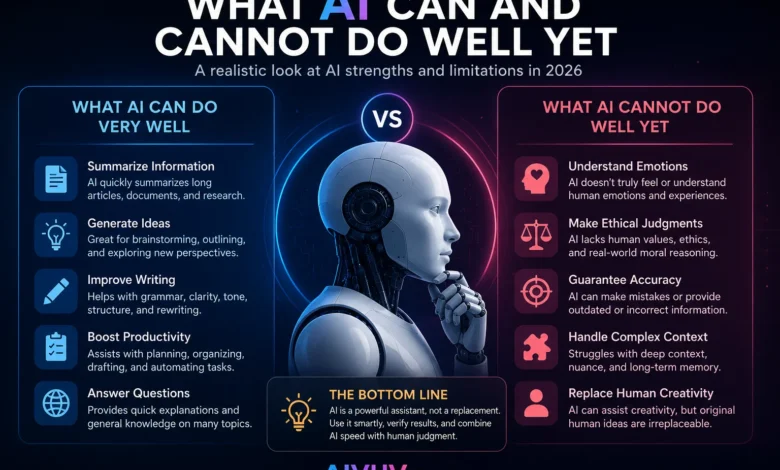
AI already performs certain tasks surprisingly well.
At the same time, important limitations still exist — even in the most advanced systems available today.
Quick Overview:
- AI excels at speed, summaries, and pattern-based tasks.
- Modern AI still struggles with reasoning consistency and judgment.
- Human review remains essential for important decisions.
- AI works best as a support tool rather than a replacement for thinking.
- Most productivity gains come from simple workflows, not endless automation.
Why People Misunderstand AI So Easily
Part of the confusion comes from how AI systems communicate.
Modern AI tools sound confident.
Responses often appear polished, organized, and highly readable.
That smooth communication style can create the illusion of deeper understanding than what actually exists underneath.
Social media makes the situation even more exaggerated.
Online discussions regularly swing between:
- “AI will replace everything.”
- “AI is completely useless.”
Neither view reflects reality accurately.
AI systems are extremely capable in some areas and surprisingly limited in others at the exact same time.
What AI Already Does Very Well
Certain tasks fit AI systems naturally because they depend heavily on patterns, structure, and language prediction.
That explains why AI tools became useful so quickly for productivity workflows.
1. Summarization
This remains one of AI’s strongest abilities today.
AI tools can process large amounts of text quickly and generate simplified summaries in seconds.
People use this constantly for:
- Study notes
- Research overviews
- Meeting summaries
- Articles
- Documents
The time savings can feel enormous.
Still, summaries sometimes remove nuance or important context.
2. Brainstorming and Idea Generation
AI performs surprisingly well during early-stage idea generation.
Writers, students, marketers, and creators often use AI to:
- Generate outlines
- Explore angles
- Find examples
- Expand concepts
- Organize rough thoughts
That support becomes useful because creative blocks often come from momentum problems rather than lack of intelligence.
3. Productivity and Organization
Modern AI tools help organize repetitive tasks effectively.
Common examples include:
- Email drafting
- Task breakdowns
- Workflow organization
- Schedule planning
- Content formatting
Funny enough, the best productivity gains usually come from simple automation rather than overly complicated systems.
4. Language Assistance
AI became extremely popular for writing support.
Many users rely on AI for:
- Grammar correction
- Sentence rewriting
- Clarity improvements
- Tone adjustments
- Translation support
For non-native English speakers especially, these tools can remove a huge amount of friction.
What AI Still Struggles With
Despite rapid progress, important limitations remain surprisingly visible.
Some problems improved significantly over time.
Others still appear regularly even in advanced systems.
1. Reliable Fact Accuracy
This remains one of the biggest weaknesses.
AI tools sometimes generate:
- Incorrect facts
- Fake references
- Outdated information
- Invented details
The problem becomes dangerous because incorrect answers often sound completely believable.
Good wording does not guarantee reliable information.
2. Human Judgment
AI can organize information quickly.
It still struggles with judgment involving:
- Ethics
- Emotion
- Long-term consequences
- Human relationships
- Complex tradeoffs
That limitation matters more than many beginners realize initially.
3. Deep Understanding
AI systems generate responses by recognizing patterns from training data.
That process creates impressive outputs.
Still, the system does not “understand” information the same way humans do.
Sometimes AI produces answers that appear intelligent while quietly missing deeper context underneath.
4. Consistent Reasoning
Long reasoning chains still create problems occasionally.
AI may:
- Contradict itself
- Lose context
- Skip logical steps
- Drift during complex explanations
This becomes especially noticeable during technical or highly detailed discussions.
Why AI Feels More Human Than It Actually Is
This part surprises many beginners.
Modern AI systems mimic human conversation styles extremely well.
That realism creates emotional reactions naturally.
People sometimes assume the system truly understands feelings, intentions, or personal meaning.
In reality, AI generates responses through statistical language prediction rather than conscious understanding.
The emotional tone comes from learned communication patterns.
Can AI Replace Human Creativity?
This debate appears constantly online.
AI already assists creative work heavily:
- Writing
- Design ideas
- Brainstorming
- Music experiments
- Visual concepts
Still, human creativity involves:
- Experience
- Emotion
- Taste
- Cultural understanding
- Personal perspective
AI can support creative workflows extremely well.
That does not automatically replace human originality completely.
What Smart AI Users Usually Understand
Experienced users eventually stop expecting perfection from AI systems.
Instead, they focus on practical strengths:
- Speed
- Organization
- Drafting
- Idea generation
- Workflow support
At the same time, they continue reviewing outputs critically.
That balance matters enormously.
Healthy AI Workflow:
- Use AI for support and organization.
- Verify important information manually.
- Keep workflows simple.
- Avoid blind trust in outputs.
- Combine AI speed with human judgment.
Useful Resources
Final Thoughts
AI already changed productivity, research, writing, and organization dramatically.
Still, important limitations remain visible even in 2026.
The strongest AI workflows usually come from realistic expectations rather than hype.
Funny enough, experienced users often rely on simpler systems than beginners expect.
Not because AI lacks value.
Because human attention, judgment, and critical thinking still matter enormously.
AI works best when supporting human capability — not replacing it completely.
Frequently Asked Questions
What does AI do best today?
AI performs very well at summaries, drafting, brainstorming, organization, and repetitive language-based tasks.
What are the biggest limitations of AI?
Major limitations include unreliable facts, weak judgment, inconsistent reasoning, and lack of true understanding.
Can AI replace human creativity?
AI can support creative work effectively, but human experience, emotion, and perspective still matter greatly.
Why do AI tools sometimes sound overconfident?
Modern AI systems generate polished language patterns that can sound highly convincing even when information is inaccurate.
Should people trust AI completely?
No. Important information should still be reviewed and verified carefully by humans.