Most beginners enter the AI world excited.
That excitement makes sense.
AI tools now write articles, summarize research, organize workflows, generate images, explain concepts, and automate repetitive tasks faster than many people expected only a few years ago.
Still, something interesting keeps happening.
Even with better tools available everywhere, beginners continue making many of the same mistakes repeatedly.
Some mistakes waste time.
Others quietly reduce learning, productivity, or content quality without people noticing immediately.
Funny enough, the biggest problems usually do not come from weak technology.
They come from unrealistic expectations and poor workflows instead.
Quick Overview:
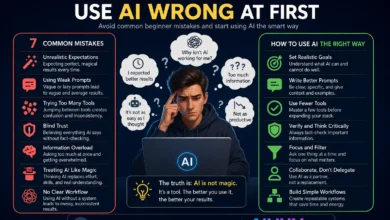
- Most AI mistakes come from unrealistic expectations.
- AI still requires human judgment and fact-checking.
- Too many tools create unnecessary complexity.
- Weak prompts often produce weak outputs.
- Good AI workflows usually stay simple.
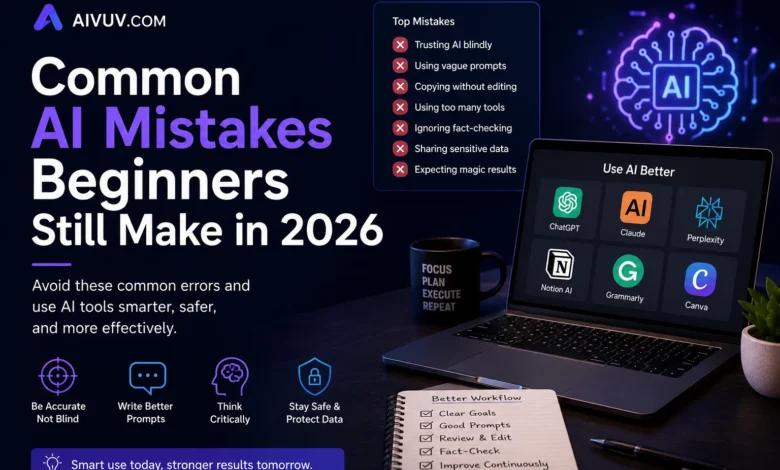
1. Treating AI Like It Is Always Correct
This remains one of the biggest beginner mistakes today.
Many people assume AI responses are accurate because the writing sounds smooth and confident.
That confidence can become misleading.
AI systems still make mistakes regularly:
- Incorrect information
- Fake references
- Outdated details
- Oversimplified explanations
- Misunderstood context
Good writing does not automatically mean good information.
Clear wording can sometimes hide weak accuracy surprisingly well.
Beginners who skip fact-checking usually run into problems eventually.
2. Using Extremely Vague Prompts
This mistake appears constantly.
Beginners type prompts like:
- “Write article”
- “Explain SEO”
- “Best business ideas”
- “Help me study”
Technically, AI can answer those prompts.
The problem is that vague instructions force the model to guess what the user actually wants.
Weak prompts usually create weak outputs.
Adding context improves response quality dramatically:
- Audience
- Goal
- Tone
- Complexity level
- Formatting preferences
Small details make a surprisingly large difference.
3. Relying Completely on AI for Writing
This mistake became much more common recently.
Some beginners copy AI-generated content directly without reviewing, editing, or improving anything manually.
That approach usually creates several problems:
- Repetitive writing
- Weak originality
- Low engagement
- Generic structure
- Thin insights
Readers notice that feeling quickly.
Search engines notice it too.
The strongest AI-assisted content still includes human editing, judgment, examples, and refinement.
4. Using Too Many AI Tools Simultaneously
This happens surprisingly often once beginners enter the AI productivity space.
One app handles writing.
Another manages notes.
A third summarizes research.
Then several more tools appear for automation, scheduling, brainstorming, and organization.
Eventually, workflows become fragmented across multiple platforms.
The irony becomes difficult to ignore.
Tools designed to improve productivity often create a different kind of overwhelm instead.
Better Beginner Approach:
- Choose a few reliable tools.
- Learn basic workflows first.
- Avoid unnecessary complexity.
- Expand slowly over time.
5. Expecting AI To Replace Learning Completely
This expectation creates problems quietly.
AI tools can explain concepts faster than traditional search engines in many situations.
That convenience feels powerful.
Still, reading summaries is not always the same as understanding information deeply.
Students often notice this during exams.
Professionals notice it during real-world problem solving where surface-level familiarity suddenly becomes insufficient.
AI can support learning extremely well.
It should not completely replace thinking.
6. Chasing Every New AI Trend
The AI industry moves incredibly fast now.
Every week, another “revolutionary” tool appears online.
Beginners often jump constantly between platforms searching for perfect workflows.
Most experienced users eventually simplify instead.
Stable systems usually outperform chaotic experimentation long term.
7. Ignoring Privacy and Sensitive Information
Many beginners share too much information with AI tools without thinking carefully.
That includes:
- Private business data
- Personal documents
- Passwords
- Sensitive client information
- Confidential work material
AI tools are useful.
That does not mean every piece of information should be uploaded casually.
Understanding privacy basics matters more now than many users realize.
8. Believing AI Automatically Creates Productivity
This misconception appears constantly in productivity culture.
People assume automation instantly fixes focus problems, workflow issues, or poor habits.
Usually, AI tools amplify existing systems rather than replacing them completely.
Someone already organized may become more efficient.
Someone constantly distracted often becomes distracted across even more complicated systems.
Technology alone rarely fixes foundational habit problems.
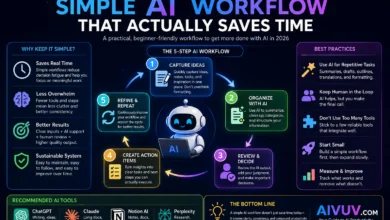
Why Simpler AI Workflows Usually Work Better
One pattern appears repeatedly across experienced users.
The strongest workflows usually stay lightweight.
Instead of managing countless apps, many people settle into:
- One writing assistant
- One research tool
- One organization platform
- One simple workflow
Simple systems survive longer because they create less mental overhead.
What Beginners Should Focus On Instead
Rather than chasing perfect automation, beginners usually benefit more from:
- Learning prompting basics
- Fact-checking information
- Building sustainable workflows
- Using fewer tools consistently
- Improving communication skills
That foundation matters far more long term than collecting every new AI platform online.
Useful Resources
Final Thoughts
Most beginners still make similar AI mistakes in 2026 because expectations often move faster than understanding.
AI tools are powerful.
Still, they work best when combined with human judgment, clear workflows, realistic expectations, and consistent learning.
Funny enough, many experienced users eventually move toward simpler systems after spending months experimenting with complicated setups.
Not because AI lacks value.
Because sustainable workflows usually matter more than endless automation.
The strongest beginner strategy is surprisingly simple:
Use fewer tools. Learn them properly. Think critically. Refine gradually.
That approach works far better long term than chasing every AI trend online.
Frequently Asked Questions
What is the biggest AI mistake beginners make?
Many beginners trust AI outputs too quickly without fact-checking or reviewing information carefully.
Can AI replace learning completely?
No. AI can support learning and productivity, but critical thinking and deep understanding still matter enormously.
Why do beginners struggle with AI tools?
Most struggles come from unrealistic expectations, weak prompts, and overly complicated workflows.
Should beginners use many AI tools?
Usually not. Simple workflows built around a few reliable tools are easier to maintain long term.
Are AI-generated answers always accurate?
No. AI tools can still generate incorrect, outdated, or misleading information sometimes.