Most beginners think ChatGPT works like magic at first.
You type something quickly. A response appears seconds later. Sometimes it sounds surprisingly smart.
Then the strange part starts happening.
The next answer feels weak. Another one sounds repetitive. A different response completely misunderstands the question.
Eventually, many people start wondering whether the AI is inconsistent or simply overrated.
Usually, the real problem starts somewhere else.
The prompt itself.
Funny enough, tiny wording changes often improve output quality more than beginners expect.
Quick Overview:
- Better prompts create better AI responses.
- Clear context improves accuracy significantly.
- Simple prompts often work better than complicated ones.
- Follow-up prompts matter more than beginners realize.
- Prompting improves with practice and experimentation.
Most Beginners Use Extremely Broad Prompts
This happens constantly with new users.
People type prompts like:
- “Write article”
- “Explain SEO”
- “Best business ideas”
- “Help me study”
Technically, ChatGPT can respond to those requests.
The problem is that vague prompts force the system to guess what the user actually wants.
That guessing creates weaker responses surprisingly often.
One user wants a beginner explanation. Another expects advanced detail. Someone else only needs a quick summary.
Without enough context, the AI fills those gaps on its own.
Most weak AI outputs begin with unclear instructions rather than weak technology.
Why Context Changes Response Quality So Much
Most beginners underestimate how important context really is.
Even one additional sentence can completely change the quality of a response.
Weak Prompt:
“Explain email marketing.”
Improved Prompt:
“Explain email marketing to a beginner running a small online store. Focus on practical beginner strategies instead of advanced technical terms.”
The second prompt quietly improves several things:
- Audience clarity
- Topic direction
- Complexity level
- Writing tone
- Practical relevance
That sounds minor initially.
In practice, it changes the entire interaction.
Good Prompts Usually Stay Surprisingly Simple
Many beginners overcomplicate prompting immediately.
Huge instructions. Massive formatting requests. Endless details.
Sometimes simpler prompts work better because they reduce confusion.
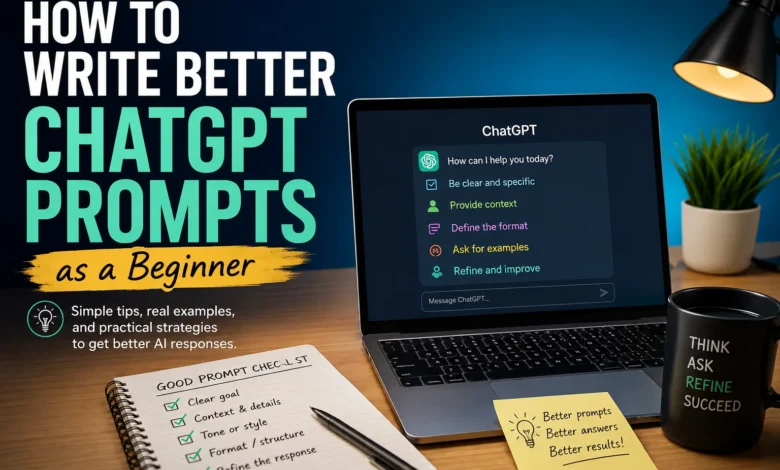
The strongest prompts usually explain:
- What the user wants
- Who the audience is
- What style is needed
- How detailed the answer should be
- What should be avoided
That structure matters more than fancy wording.
Why Follow-Up Prompts Matter So Much
This is one of the biggest things beginners miss.
Most people stop after the first response.
Experienced users rarely do that.
Instead, they continue refining outputs step by step:
- “Simplify this explanation.”
- “Add practical examples.”
- “Rewrite this for beginners.”
- “Make the tone more conversational.”
- “Shorten this section.”
Prompting works better as an ongoing conversation rather than a single request.
Honestly, many excellent outputs only appear after two or three rounds of refinement.
Most Prompting Mistakes Come From Overloading Requests
Some users go from vague prompts to the opposite extreme.
Suddenly one prompt asks for:
- Research
- SEO optimization
- Business strategy
- Predictions
- Social media ideas
- Content writing
All inside the same request.
The result usually becomes shallow because the task itself lacks focus.
Breaking larger goals into smaller stages almost always improves output quality.
ChatGPT Still Needs Human Judgment
This part matters more now than many beginners realize.
AI responses often sound confident even when details underneath become questionable.
ChatGPT can still:
- Generate inaccurate information
- Invent references
- Oversimplify topics
- Miss nuance
- Misunderstand context
Clear wording does not automatically mean correct information.
Fluent writing can sometimes hide weak information surprisingly well.
Why Prompting Improves With Experience
Prompting behaves more like communication practice than technical magic.
Over time, users start noticing patterns:
- What creates vague outputs
- What improves clarity
- What causes repetition
- What produces stronger structure
Eventually, small wording adjustments become easier naturally.
That learning process happens faster than most people expect.
The Best AI Workflows Usually Feel Natural
Many beginners chase “perfect prompts” constantly.
Experienced users often focus on something simpler instead:
- Clear goals
- Focused instructions
- Small refinements
- Iterative feedback
- Practical experimentation
Good prompting usually feels conversational rather than mechanical.
Simple Prompt Formula for Beginners
Basic Prompt Structure:
- Explain the task clearly.
- Define the audience.
- Mention tone or style.
- Set reasonable limits.
- Refine the response afterward.
That structure alone already improves results dramatically for most beginners.
What Makes a Prompt Actually Effective?
After testing AI tools repeatedly, one pattern becomes obvious very quickly.
The best prompts usually combine:
- Clarity
- Specific intent
- Simple language
- Useful context
- Follow-up refinement
Not complexity.
Not “secret prompt tricks.”
Just clear communication.
Useful Resources
Final Thoughts
Most beginners struggle with prompting because they expect ChatGPT to automatically understand vague instructions perfectly.
Usually, stronger results come from clearer communication instead.
Good prompts do not need complicated formulas.
They need structure.
Clear goals. Useful context. Reasonable constraints. Small refinements.
Funny enough, prompting becomes much easier once people stop searching for “perfect prompts” and start treating AI more like a collaborative tool.
That shift alone improves results more than most beginners expect.
Frequently Asked Questions
Why do beginners struggle with ChatGPT prompts?
Most beginners use vague prompts without enough context, which forces the AI to guess what they actually want.
Do longer prompts always work better?
No. Clear and focused prompts usually perform better than overly complicated instructions.
Should beginners use follow-up prompts?
Absolutely. Follow-up prompts improve clarity, detail, structure, and overall response quality significantly.
Can ChatGPT misunderstand prompts?
Yes. Unclear or overloaded prompts often create inaccurate or unfocused responses.
What is the best way to improve prompting?
Practice, experimentation, and learning how small wording changes affect outputs usually improve prompting skills over time.